


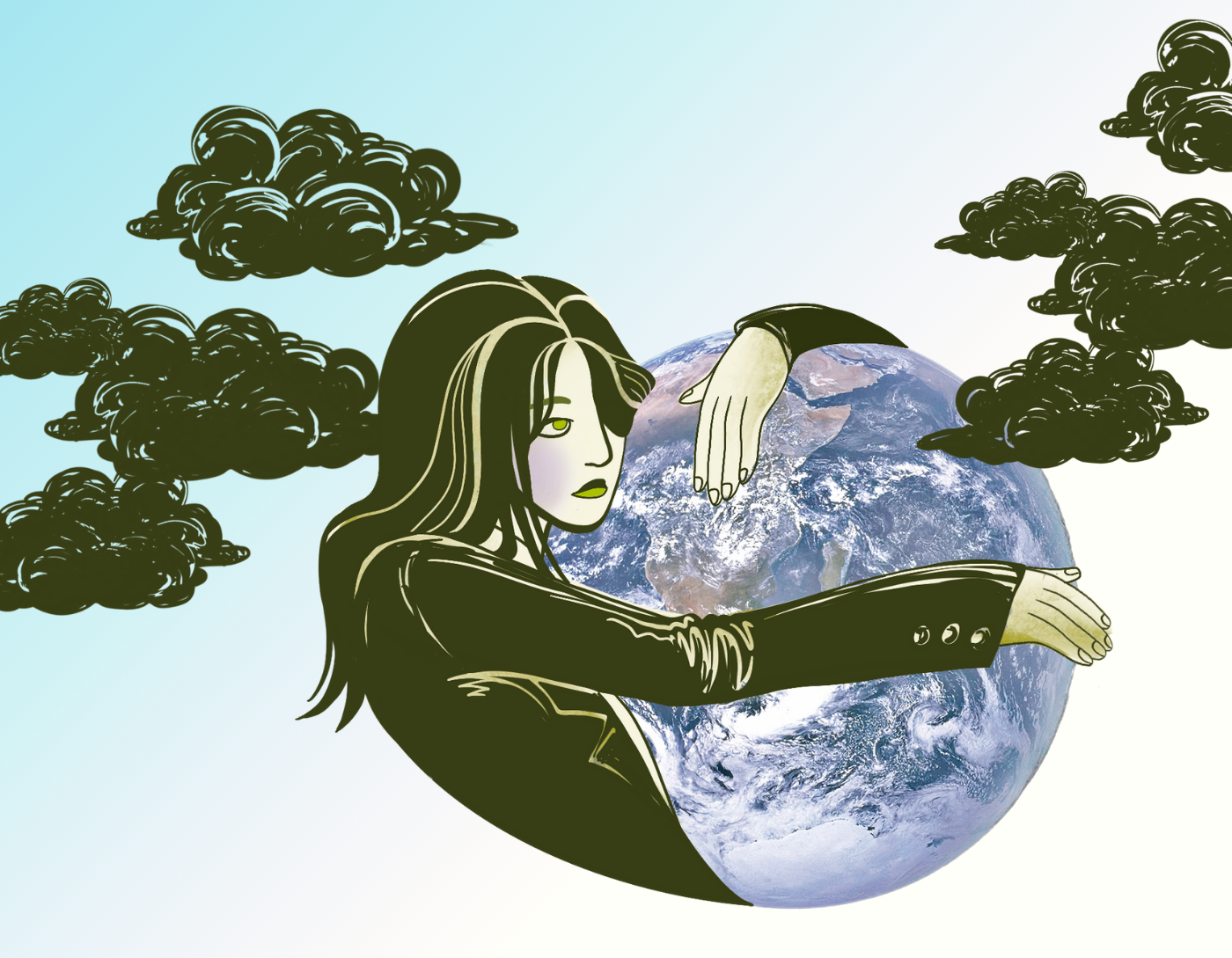
Dilemmas of a Renegade Economist
Renegade Economist - This is a title that author and Oxford professor Kate Raworth has been called, and one that I would be more than proud to one day earn. My sister said that I already am one. Maybe I am becoming one.
By a renegade economist, I mean someone who is fighting for a more ecologically and socially sustainable, fairer and kinder, economic system. During this past year, I have read a lot about economic systems, and have arrived at many profound realizations. One of them is what economist Anni Marttinen writes in her book Hattaratalous: "You, who are currently studying economics and feel that you are different, because you also care about environmental and human rights issues – you can be an economist all the same."
I see change – system-level, fundamental change – as a necessity for our survival. This is what fuels my activism and passion for demanding it. It’s why I engage in hard discussions even in rooms in which I am the only one pointing out a sustainability angle: I can't unsee it anymore, I can't look away.
And yet, I am a person who really values calmness, kindness, and peace. I am a sensitive soul and I want to spend my time being happy. This brings me to a dilemma: Is sustainability work inherently in conflict with this desire?
Not only do I love tranquility and kindness, I also have a hard time making someone upset. I would love to have everyone like me, or at least avoid having anyone be angry at me... But I am starting to realize that I may have to learn to tolerate this discomfort, if I am to continue working in sustainability.
Sustainability work, at its core, centers around challenging the status quo. It's about trying to change things, and nothing changes without resistance. Let alone the economic system or the discipline of economics. As Donella Meadows (1999) writes in her analysis of how systems are changed: “The higher the leverage point, the more the system will resist changing it — that’s why societies tend to rub out truly enlightened beings.”
It was really moving for me to see a Danish human rights activist and author Emma Holten speak at a Doughnut Economics Summer School at the University of Copenhagen in August this year. Her recent book Deficit: How Feminist Economics Can Change Our World (2024, suom. Kuluerä) criticizes the fundamental assumptions about value in mainstream economics, taking a feminist economics angle to valuation of care work, nature and all things that make us human.
Holten shared in her talk in Copenhagen how she'd received violent pushback from established economists for her book. She was ridiculed, belittled, and her right to talk about economics was questioned.
Still, she was there. She spoke with such a firm passion, determination, and hope that it gave me chills. At the end, she received a very long standing ovation from the 250 of us listening. Despite the backlash from mainstream economists, Deficit has now sold over 50,000 copies and has been translated into 12 languages.
Emma Holten is also what I would call a renegade. I would love to ask her: How do you balance wanting to live in peace with fighting for something that's important to you?
A friend of mine worded this really well: “It is also true that you can't truly live in peace without fighting for what’s important to you.” One thing that tames my climate anxiety is that I am actively engaging in sustainability discussions. If I stepped away from everything, I would start feeling like I am not myself. At the end of the day, my ideal 'me' is not someone who kept everyone happy, but someone who spoke her truth, and stayed true to herself.
Finally, turning to my second dilemma. Another book that had a profound influence on me this year is Moral Ambition (2024) by Rutger Bregman. As an example of people who changed the world, he introduces Thomas Clarkson, a leading activist for ending slavery in England in the late 1700s to early 1800s. Slavery was ended in England in his lifetime, but Clarkson also experienced utter exhaustion and a collapse of his health at age 34, and stayed away from work for 11 years. Bregman shares many similar stories and emphasizes: even if we want to change the world, we have to take care of ourselves first. Not because "that way we can do the most good", but because everyone is valuable as they are.
Sustainability work, as it is my passion, can easily take too tight a grip of me and swallow me whole. I can feel the threat of a burnout looming over me; But I don't want to lose my joy. I don't want to stop living in the moment, stop being playful. There is so much good in the world, and ultimately, that is also the reason why I do activism: To protect the good. I shall also remember to protect it in me. You shall remember to protect it in you, too.
These are the dilemmas I have thought about lately.
The author is a master’s student in economics who listens critically to everything she hears on her lectures. Her dream is a healthy, happy planet on which there is no need for climate activism.


